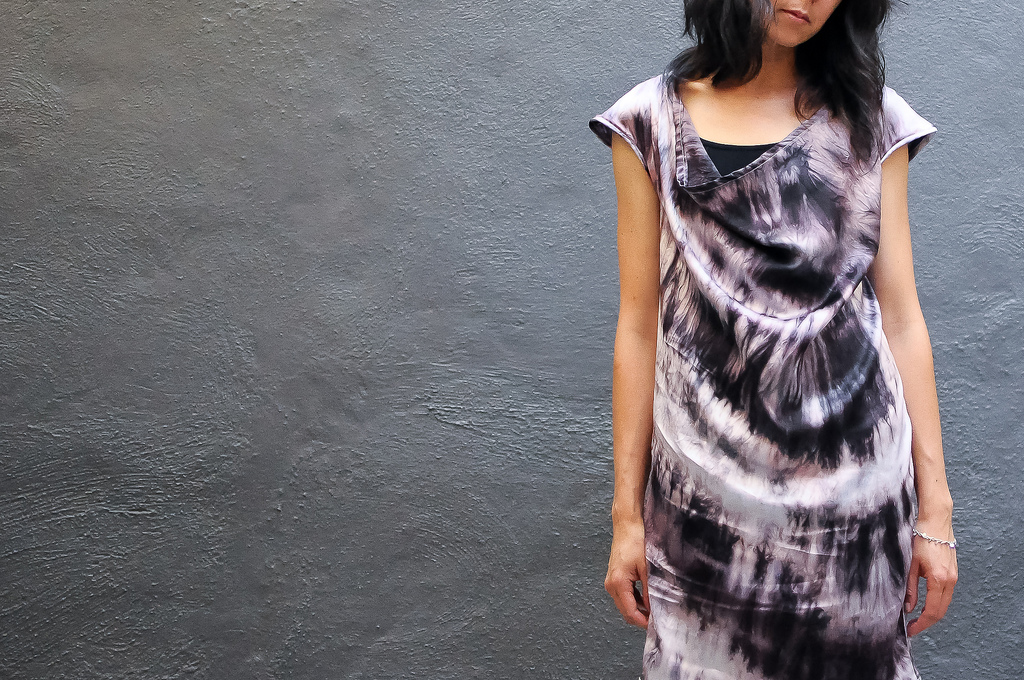
Here it is, my indigo-dyed, shibori dress. I’m so in love with it.
When choosing the pattern for this project, I wanted to choose a fairly simple dress that had sleeves to show off the shibori pattern. Rather than try to cover the entire dress with the pattern, I focused on having it clustered around the bottom of all the pieces. To get the specific placement, I cut out all my pattern pieces out of white muslin, serged all the edges and did the shibori right on each dress piece.
The pattern is dress “V” from Stylish Dress Book 2. This is actually the first dress I’ve made from this book. I’m just finishing off a second one this week. Melinda made this particular dress a few months ago, so I already knew how cute it was. Choosing the contrasting fabric to go with it was difficult. I’m pretty sure I pulled every navy bolt of fabric off the shelf before finally settling on this floral print from Windham. I also made fabric covered buttons using this fabric for the placket. Having matching buttons always makes a project feel polished.
This dress was simple to make. It has lots of pretty gathering on the neckline and sleeves. I did mess up one part though. I failed to add seam allowance to the placket down the centre, so I had an extra big hole down the centre of the dress. To fix it, I just created a little centre pleat below the placket which brought together the edges of the placket hole. Mistakes often lead to creative solutions, so I always try to avoid getting too upset when I realize that I’ve done something ‘wrong’.
This is my favourite dress so far. I’m really, really proud of it. I definitely want to keep experimenting with natural dyeing fabrics to make more clothing. The soft, uneven texture looks so beautiful. I even have the beginnings of an idea to do a quilt with only natural dyed fabrics.


The last day of the Natural Dyeing class was all about indigo dyeing. I’ve always admired Japanese shibori dyeing, so I couldn’t wait to try it out in this class. Shibori is a method of creating patterns on fabric during the dyeing process by binding, stitching, folding, twisting, or compressing it.
I got the idea to dye fabric for a dress from Melissa and pre-cut and serged all my pieces beforehand. This way I could plan exactly where the shibori would be located on the dress. I used a pure white muslin rather than a natural coloured one to keep the blue clearer. To create my design I placed screws (of various sizes and shapes) underneath my fabric and wrapped each one up tightly with heavy upholstery thread. This is a fairly labour intensive type of shibori, but I really liked the circular patterns it creates.
Deeper blue colours are achieved through repeated immersion into the dye vat. I was able to dip my pieces into the vat four times. It’s a bit hard to tell what the colour will dry as, it is always much darker when it’s wet. When I unwrapped all the screws, several of them had transferred rust marks onto the fabric which I actually really like. The fabric dried to a really nice blue and I even like the slightly uneven colouring, it gives it a vintage feel.
Shibori tights? Yes, please!
Next post – the finished dress!


Natural dyeing is something I’ve been wanting to try for a very long time. The idea of one day growing things in my backyard that I can harvest and then dye my own fabrics with is incredibly exciting. When I browse through seed catalogs, I’m always taking note of the plants that are candidates for my future dye garden. When I caught wind that Julie Sinden had lots of amazing experience in the field, I set the wheels in motion to set up a class as quickly as possible.
The class was pretty magical. It opened up a whole new world of possibility with textiles and sewing for me. Just the history alone of where these natural dyes came from is so interesting. Also, natural dyes are not exactly what I thought – you can’t actually use beets to dye fabric or yarn, as it won’t last and neither will turmeric. Pomegranate skins will give you a yellow-ish colour, not pink or red. Rhubarb root, mushrooms, oak leaves and walnut husks are all possible dyes that I’m interested in trying. I’m cooking up some future dyeing projects for myself already.
The last day of the class we did indigo dyeing which is a post all on its’ own.
Just look at all this yummy colour!


First. Thank you for the super positive response on my cross stitch pendants! I’m so happy you like them. Seriously. Yeah!! I definitely want to make sure you can get your hands on some blanks, so that I can see what amazing things you’ll do with them. Stay tuned for the refined versions that will be for sale, very soon.
Next. Okay, these are not the completed arcs, they are just the arc segments. I still have a wee bit of homework to do before my next Double Wedding Ring Quilt class on Thursday. So far, I’m on track and amazed (again) at how smart our teacher, Miss Johanna is. Look at how cute those 216 little pairs are!
I found some wonderful vintage quilt inspiration here. {via Inspiration Resource}
And I spent way to long browsing through all the lovely colour-arranged photos here. Gorgeousness.


After a lot of hemming and hawing, I’ve finally decided on my colours and fabrics for my Double Wedding Ring quilt. The class is finally starting this Thursday!
Originally, I was thinking red, blue and cream. This palette has been refined to coral, aqua, navy and creams with multi-colours. The inspiration basically came from all the new fabrics that came last week. The new Tula Pink ‘Neptune’ collection and Anna Maria Horner ‘Good Folk’ collection are so pretty that I can’t resist including them in this quilt. The background will be a soft grey Anna Griffin fabric.
I’m really excited, it’s been a while since I’ve done one of Johanna’s quilting classes. Her clever tips and tricks are always so invaluable. If I can stay on track then it’s possible I’ll have a completed quilt in four weeks!


I have a new obsession.
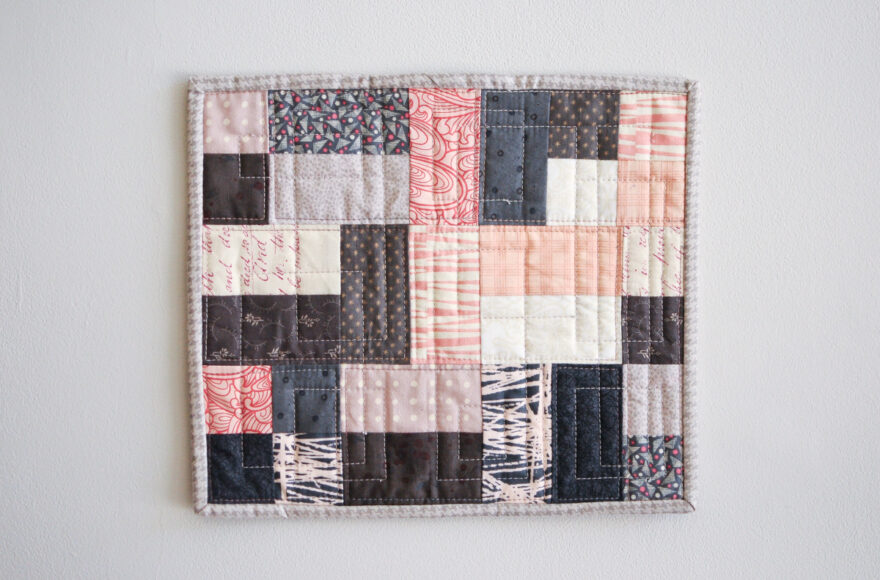
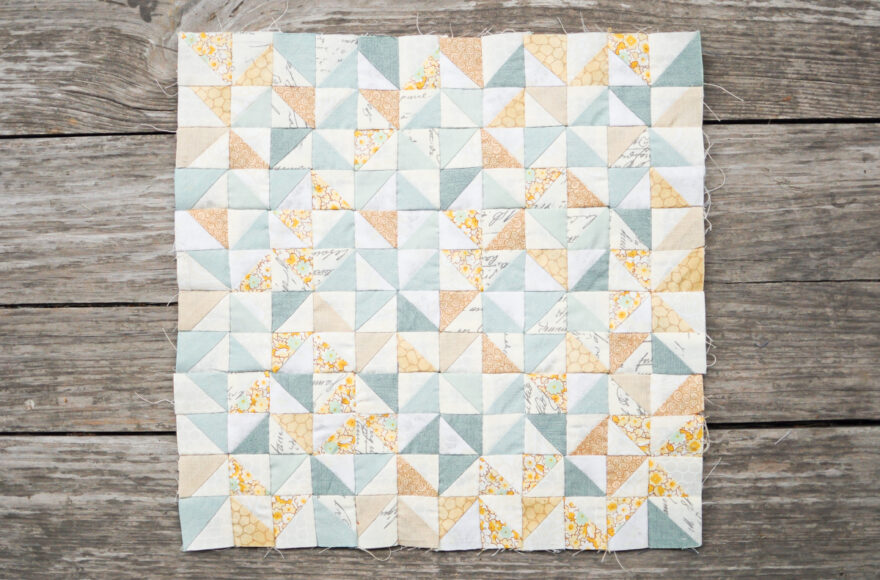
Over the weekend I started making these mini log cabin blocks from scrap fabrics from my stash and from the scrap bin at the workroom. I collected all my favourite scraps and then sorted them all by colour. Then I started creating little mini colour palettes for each log cabin block and so it began…
Here’s what I love about this. Each tiny block is an exercise in colour. I can try out dozens of different colour palettes without committing to an entire quilt or large scale project. I can be experimental, spontaneous and playful without worrying about the outcome. It’s soo much fun!
Also, I’m using up tiny scraps. A lot of these are leftovers from all my past projects or leftovers from YOUR past projects. I’ve been swiping your little scrap bin throwaways for months and finally I’m using them.
This particular block was inspired by a spread in one of my visual diaries. I’ve been making these visual diaries/collage/scrap/inspiration books since university. It is one of my favourite all-time activities to sit down with my bottle of rubber cement and endlessly arrange the bits and pieces of magazines clippings and ephemera that I collect. Every time I open one of my books I’m immediately inspired. This particular colour palette stood out and I gathered my orange, grey and navy scraps. These are colours that I never would have put together on my own, but they look so delicious!
A crafty nod goes to Jen, whose log cabin heart medallions made me want to do tiny patchwork.


I’m so so pleased with how this pieced quilt back turned out. Not to mention impressed with how quickly I was able to sew it up. As you can see, it only vaguely resembles my initial schematic.
My goal was to use up scrap pieces of fabric from the quilt front, from other projects and from ends of bolts from the workroom. I also really wanted to include a few fabrics that I had collected over the years. The turquoise leaves on cream was an ebay purchase a couple years ago that I hoped would go into my first quilt. The dark grey Lecien fabric along the bottom was the only fabric that I got in quantity specifically for the back.
Using the schematic as my guide, I worked in sections, starting with the top right yellow block. Within each section I often had to piece several different fabrics together to make up the correct dimension that i needed. Mostly I let the fabric dictate where it would go. There was a definite feeling of synchronicity, as I laid the fabrics on the floor according to their size and colour.
Once I put together a section, I worked on the adjacent section and then attached the two sections together. I made a couple ‘mistakes’ by attaching sections before I meant to which lead to a different configuration. I also rotated one section ninety degrees because the fabric patches seemed to be too lined up in the centre of the quilt. I kept running halfway up the stairs to look at how it was coming together from above. The aerial view was very helpful. I would also go all the way upstairs for a minute and return to see how it looked as I was descending and the quilt was ‘revealed’. Ridiculous, I know, but do you know what I mean?
One of my favourite details is the mini patchwork stripe the runs across the bottom. This is made up of all my scrap cut offs from the quilt front blocks. I sewed the little pieced strips together into two very long strips which I trimmed and sewed to each other. I plan on doing a couple sets of pillow cases, also using this detail.
I guess this means I now have to baste this massive thing together. Oh geez. I’m going to hand quilt the entire thing, so it might be a while before you see it again in its entirety. Just know that I’ll be sitting in front of the tv over the fall happily stitching away.


Today I decided to embark on a little photo project involving colour. I’m not exactly sure where it’s going to go, but I’m feeling the need to do some colour exploration.
Also, I’ve been wanting to try smocking since I wrote about Tinctory. Now that I’ve found this tutorial {via whip up}, it’s going on the list.
p.s. I couldn’t help myself. I just bought bought this as a birthday treat to myself. It’s not for a couple weeks, but hopefully it will arrive just in time.